
Mentorship Unfiltered: Alison Graham & Fletcher York
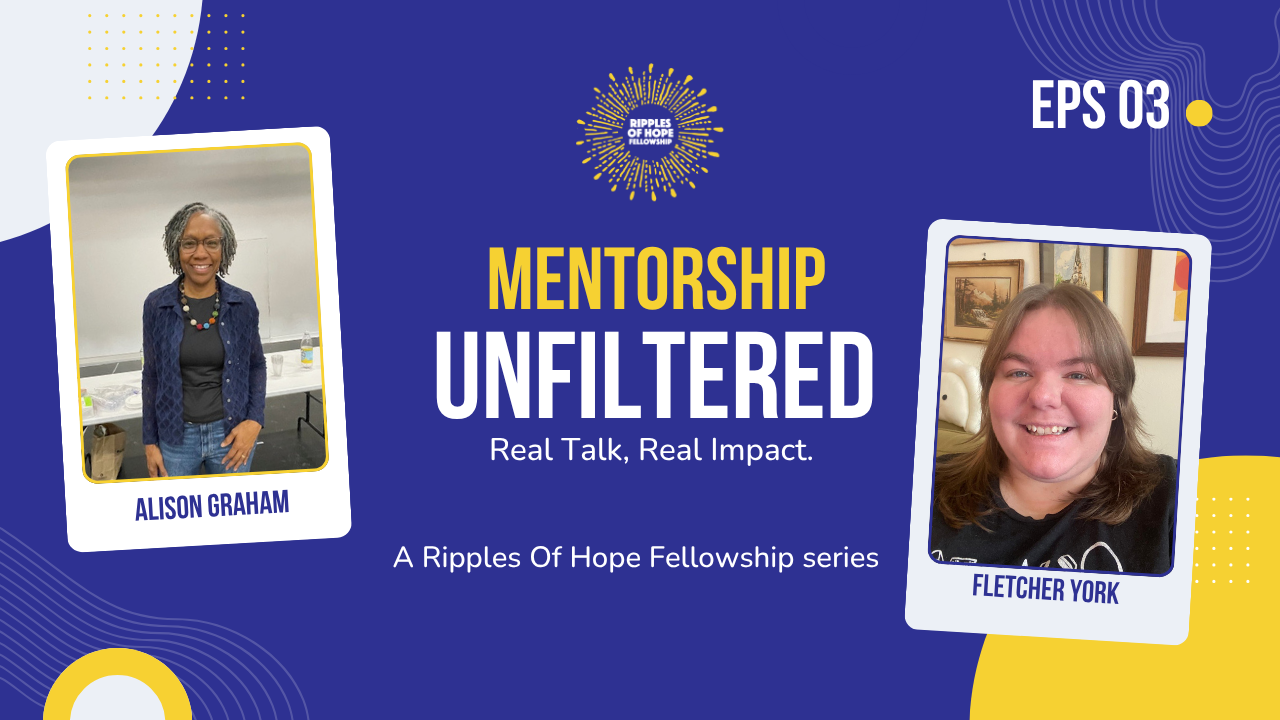
A Beacon and a Bridge: Alison & Fletcher's Story
by Thando Mzimela | Class of 2026 Fellow
There's a special vulnerability that comes with being adrift. When everything feels uncertain, when rejection piles up, when you can't quite remember who you were before the world kept saying "no", that's when you need someone to believe in you more than you believe in yourself.
For Fletcher, that person became Alison.
And for Alison, that trust became a gift she didn't know she needed to give.
When they were paired as mentor and mentee in the Ripples of Hope Fellowship, neither knew what to expect. Fletcher was the oldest in his cohort, navigating unemployment and a crisis of confidence. Alison had never formally mentored anyone before and wasn't sure she had the answers.
What they built anyway, across nearly a thousand miles, through job rejections and personal grief, with warmth and unwavering hope, proves that mentorship at its best isn't about having all the answers. It's about showing up, believing when the other person can't, and remembering that we're all still evolving.
The Match
When Alison first learned she'd be paired with Fletcher, she was nervous. "I thought maybe I would be paired with a female from South Africa," she admits. But she'd learned something crucial over the years: we're put in situations for reasons that reveal themselves later. So she leaned in with curiosity instead of assumption.
Fletcher saw Alison's bio and felt a spark of recognition. "I learned that Alison is a teacher and incredibly passionate about supporting youth. I felt in that moment that we shared a deep-seated value and mission in life."
But connection wasn't all Fletcher was hoping for. As young adults, we move through seasons that test us and shape who we become. For Fletcher, the past few months had been one of those difficult stretches. After months of unemployment and constant rejection, his confidence had taken a knock. "I really lost sight of my strengths and who I was. I was hoping that through this mentorship I might find that again."
Alison's hope was simpler but no less profound: she wanted to learn how to mentor well and to grow in the process. "I wanted us both to be better humans on the planet."
Neither knew that the gift they were hoping to receive would end up being the gift they gave each other.
Seeing What He Couldn't See
In one of their early sessions, just months into knowing each other, Alison did something that shifted everything.
She spoke to Fletcher's strengths. Not vaguely. Not as empty encouragement. She named specific qualities she saw in him, even when he couldn't see them himself.
Fletcher teared up on the call.
"It taught me that even when we feel like a shadow of ourselves, there are those around us who can see us so clearly," he says. "You never know how much someone might need to hear it."
When Fletcher expressed feeling like maybe it was "too late" for him as the oldest person in the cohort, Alison offered him a new lens. "She told me that I brought so many strengths, experiences, and perspectives to the fellowship. That we are always evolving, and even in our lowest moments we still bring strengths to this world, even if we can't see it."
It's one thing to intellectually understand you have value. It's another to have someone insist on seeing you when you've forgotten how to see yourself.
The Gifts We Give
Mentorship often involves intangible gifts: confidence, perspective, belief. Alison gave Fletcher all of those in abundance.
But she also gave him something tangible: a laptop.
Fletcher had been applying for jobs on a barely functioning computer. Alison leveraged her network and connected him with someone who could provide a reliable laptop. "It ultimately helped me land the job I have," Fletcher says.
But the laptop wasn't the real gift. It was what it represented: Alison's willingness to do more than offer advice. She opened doors, mobilized resources, demonstrated that mentorship isn't passive. It's "What do you need?" followed by "Let me see what I can do."
For Fletcher, the biggest gift was "the feeling that someone believes in me, even when it was hard to do so myself."
That belief kept him going through rejection after rejection, reminding him to keep hope up. "I would constantly think about what Alison said, how much she believed in staying positive. It inspires me every day."
Distance Is Just Geography
Fletcher had been nervous about the long-distance nature of the mentorship. Most of his mentors had been people he could sit down with face-to-face.
"I was worried if the connection would be as strong being so far from one another," he admits.
But what he and Alison proved is that if the bond is strong, no amount of distance gets in the way. "Our connection grew and remained steadfast despite being nearly a thousand miles away. It proved to me that if the connection is there, distance doesn't matter."
For Alison, the distance meant she had to be intentional about showing up, about asking "How are you doing?" as genuine inquiry, not pleasantry.
And she learned something crucial: "I don't have to have all the answers. Sometimes we find answers together."
A Beacon in the Dark
When asked to describe Alison in one word, Fletcher struggles. "So many words come to mind." But he settles on: beacon.
"She's a beacon of light, of hope, of joy. She embodies hope and selflessness and reminds me that even in the darkness there is light."
Alison's word for Fletcher? "Cares with Humility."
"Fletcher always asks how I'm doing. He's a friend that takes genuine interest in others. He talks about his younger brother Leo with such love and joy, always wanting the best for him."
This mutual recognition speaks to something essential about their relationship. They see each other clearly, and in that seeing, they call out the best in one another.
Resilience in the Face of Everything
In the short time they've known each other, both have faced some of life's hardest moments.
Fletcher navigated unemployment, rejection, living without heat, a barely functioning computer. "I would have been stressed and emotionally out of sorts," Alison reflects. "But Fletcher didn't complain. He remained hopeful and determined."
For Alison, the hardest blow came in November when her father passed away.
Fletcher showed up. He didn't try to fix her grief. He simply asked, "How are you doing?" and meant it. He listened. He held space.
"The biggest gift has been friendship and how he cared and supported me with the loss of my dad," Alison says.
This is what great mentorship looks like: not one person holding up the other, but two people holding each other up, taking turns being the strong one.
What They've Learned
For Fletcher, this mentorship taught him that belonging isn't about age or timing or having it all figured out. "We are always evolving. Even in our lowest moments we still bring strengths to this world, even if we can't see it."
For Alison, the lesson has been about trust, trusting that she doesn't need all the answers, that listening is sometimes the most powerful thing you can offer.
Both have learned the power of speaking life into someone when they're struggling to find it themselves. Fletcher now makes it a point to tell people about the qualities he sees and admires in them. Alison knows that sometimes belief is the bridge between who someone is and who they're becoming.
Looking Forward
When asked where they see this relationship going, both are emphatic: this doesn't end when the fellowship ends.
"I hope we can continue to support each other through whatever comes next," Fletcher says. "I've learned so much from her and hope I can give back to her as much."
Alison echoes that hope: "I look forward to Fletcher visiting Boston, to watching him get involved in the nonprofit sector helping young people, and to watching his relationship with Leo continue to grow."
Nearly a thousand miles apart, they've proven that distance is just geography when the connection runs deeper.
The Ripple Effect
Perhaps the most profound gift of this mentorship is what it's taught both of them about showing up for others.
Fletcher has learned to speak out loud the good he sees in people, to not hold back appreciation because they "probably already know." They might desperately need to hear it.
Alison has learned that she doesn't need to be perfect to be a powerful mentor. She just needs to show up, listen, and trust that connection, not expertise, is what transforms people.
Fletcher was adrift. Alison helped him remember who he was. Alison was grieving. Fletcher held space for her pain. Together, they reminded each other that even in darkness, there is light.
And that light? It doesn't dim with distance. It only grows brighter the more you share it.
Fletcher and Alison are part of the Ripples of Hope Fellowship, which connects young leaders from South Africa and the United States through mentorship, immersive experiences, and a shared commitment to building beloved community